

Why This Trip?
I’ve shot the Sahara more times than I can count, and I’ll tell you the hardest part isn’t the heat or the sand in your lens — it’s the timing. Miss golden hour on Erg Chebbi by twenty minutes and you’ve lost the whole show. This weekend is built around that single truth. Two days, one camera, and the greatest hits of the Moroccan desert: dunes that turn the color of burnt orange at sunset, kasbahs glowing in warm stone, palm groves catching first light, and a night sky so thick with stars it looks like spilled salt. No filler, no marathon drives. Just you, the light, and a focused photography run through Merzouga and the Draa corridor.
About Merzouga
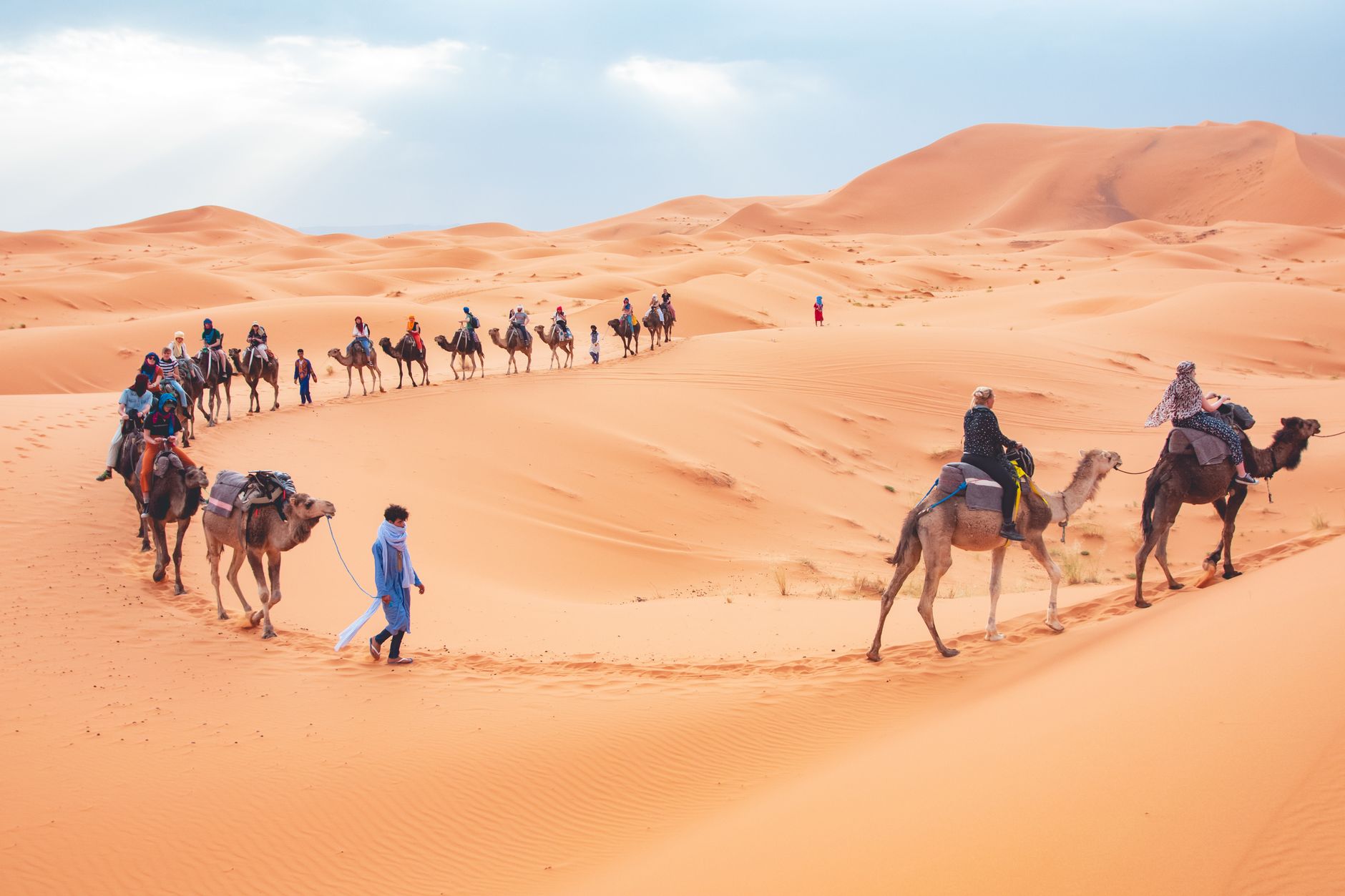
Merzouga sits in southeastern Morocco, in the Drâa-Tafilalet region, pressed right up against Erg Chebbi — a sea of orange dunes that climb to roughly 150 meters and stretch about 22 kilometers. The village is small and Amazigh to its core. It was a caravan crossroads once, a place where traders moving between the Draa Valley, the Atlas Mountains, and sub-Saharan routes would water their animals and swap news. These days it’s date farming and tourism, though the seasonal lake Dayet Srji still pulls in flamingos after a rare rain. The dunes aren’t static — the wind reshapes them every single day, which is exactly why I keep going back. The light here is hard, clean, and dramatic from the first crack of sunrise to the deep blue hour. That’s the real attraction.
One practical detail worth knowing before you commit: the dunes sit roughly 5 kilometers from the village center, and the access track crosses a stretch of flat hamada that floods after heavy rain — usually November through February. If your visit coincides with a wet spell, ask your camp whether they’re running 4×4 transfers or expect you to walk in. The reliable fallback is to book a camp on the Hassi Labied side, where the piste stays firmer, and hire a local driver for the dune sessions rather than self-driving. Drivers at the village co-operative typically charge 400-600 MAD for a two-hour golden-hour run, and they know exactly which ridge line will catch the best side-light that evening.
Your 2 days Itinerary
Day 1 — Arrival, dunes, and dusk: Get in by mid-afternoon, ditch your bags, and head straight into Erg Chebbi by 4×4 or camel for a 90-minute golden-hour session on the high ridges. I still remember the smell of cumin drifting from a roadside stall as we drove out — that’s the moment the desert hits you. Stay out through sunset and the blue hour, then back for dinner and a quick night-sky shoot if the clouds cooperate.
Day 2 — Sunrise and the Draa edge: Pre-dawn start for sunrise on the dunes. It’s brutal getting up, but watching the sun melt into the sand makes you forget the alarm. Quick breakfast, then drive the northern Draa corridor toward the kasbahs and palm groves around Tamegroute or Agdz for mid-morning architectural and landscape frames. Wrap by early afternoon for the return leg.
Where to Stay
Merzouga has three realistic tiers: simple guesthouses in the village, mid-range desert camps at the dune edge, and luxury camps deeper in Erg Chebbi. Prices swing hard by season — December through March and October are peak. Book early if you want a dune-facing tent.
| Option | Area | Vibe | Price per night |
|---|---|---|---|
| Village guesthouse | Merzouga center | Simple, local, walkable | from 250-500 MAD (~EUR 22-45) |
| Mid-range desert camp | Erg Chebbi edge | Comfortable tents, shared bathrooms | from 400-800 MAD (~EUR 35-70) |
| Luxury desert camp | Deep Erg Chebbi | Private tents, en-suite, dinner included | from 900-1,800 MAD (~EUR 80-160) |
| Kasbah-style hotel | Hassi Labied | Pool, dune views, good for photographers | from 600-1,200 MAD (~EUR 55-110) |
Getting There & Around
Most travelers reach Merzouga via Marrakech or Fes, then arrange a local 4×4 for the dunes. Public transport exists but eats time; for a two-day photography run, private transfer or a shared grand taxi is the practical choice. Within Merzouga, everything is close — you can walk between the village and the dune edge in 20-30 minutes.
| Route | Best option | Duration | Approx cost (MAD) |
|---|---|---|---|
| Marrakech to Merzouga | Private transfer or shared van | 8-9 hours | 300-600 per person |
| Fes to Merzouga | Private transfer or CTM bus + taxi | 7-8 hours | 250-500 per person |
| Errachidia to Merzouga | Grand taxi | 2 hours | 60-100 per person |
| Local dune access | 4×4 with driver-guide | 2-4 hours | 400-800 per vehicle |
Budget Estimate
Here’s the honest math from someone who’s done this run on a shoestring and on a splurge. These are realistic per-person ranges for a two-day, one-night trip in shoulder season. Costs drop fast if you share transfers and sleep in the village; they climb just as fast for luxury camps and private 4×4 guides. Eat where the locals eat — a tagine and mint tea will run you less than a mediocre hotel sandwich, and it’ll taste ten times better.
| Item | Solo (MAD / EUR) | Couple per person (MAD / EUR) |
|---|---|---|
| Accommodation | 400-900 / 35-80 | 300-700 / 27-62 |
| Food & drink | 150-300 / 13-27 | 120-250 / 11-22 |
| Getting around | 400-800 / 35-70 | 250-500 / 22-45 |
| Activities & tours | 300-700 / 27-62 | 200-500 / 18-45 |
| Total | 1,250-2,700 / 110-240 | 870-1,950 / 78-175 |
Book Your Stay on MoroccanChapter
When the light is the whole point, where you sleep matters less than how fast you can get to the dunes. MoroccanChapter lists vetted riads, guesthouses, and desert camps across Merzouga and the Draa so you can lock in a dune-facing tent or a quiet kasbah room without endless searching. Head to moroccanchapter.com, filter by area and budget, and build the two-day photography run that actually fits your schedule — then spend your energy on the shots, not the logistics.