

Why This Trip?
Most desert trips in Morocco ask for a week of your life and give you a lot of driving in return. This one doesn’t. Two days, one purpose: to stand in front of a goat-hair tent on the edge of the Draa and understand why nomads built it the way they did. I remember the first time I ran my hand along the weave of one of these tents near Zagora — coarse, oily to the touch from the lanolin, and somehow cool despite the afternoon hammering down. That’s the whole point of the trip. Sleeping in a structure built to move, not to stay, and feeling the logic of it in your bones. If you’ve got a weekend and a hunger for the real desert, this is your route.
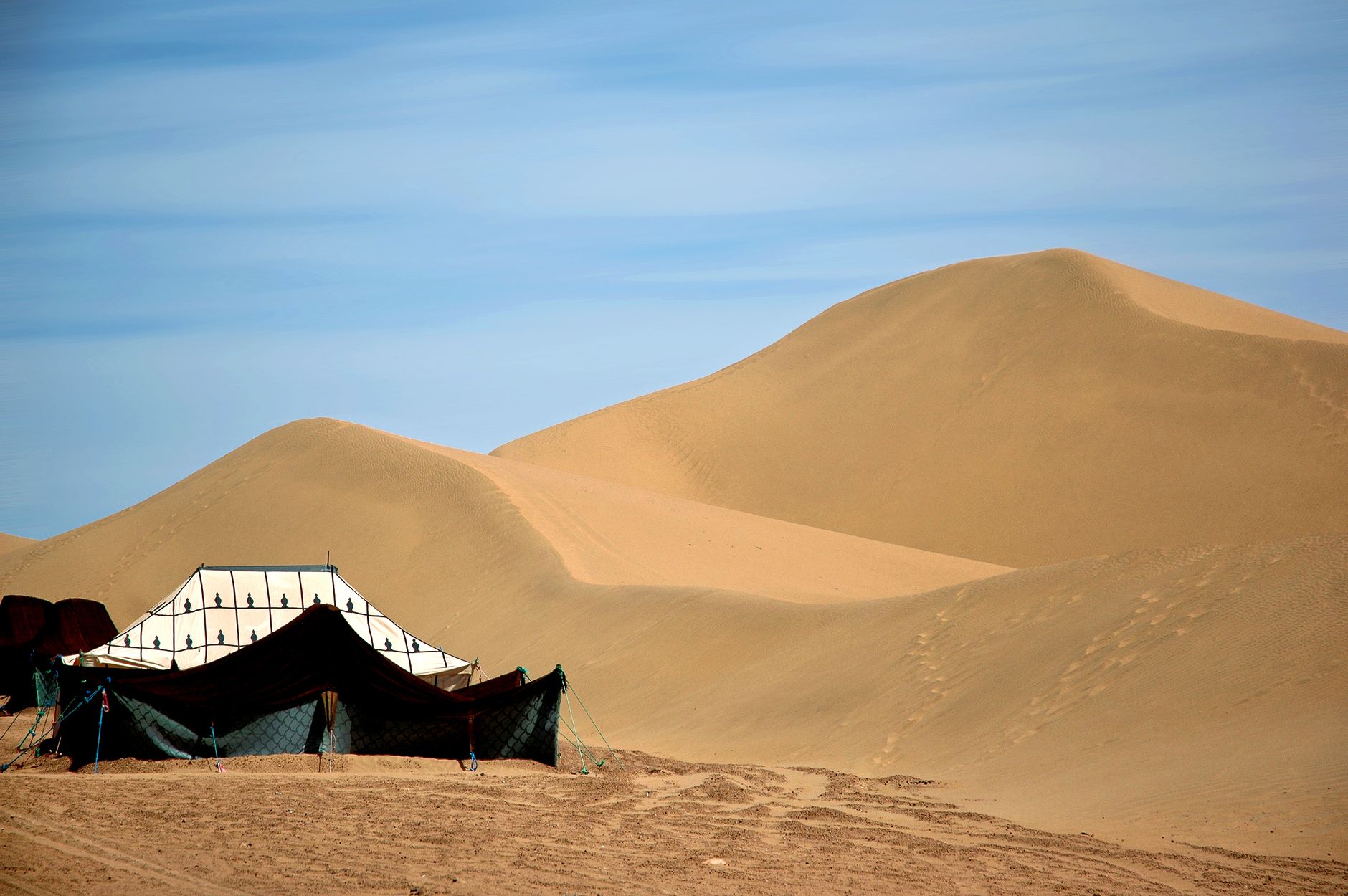
About the Draa Valley
The Draa is Morocco’s longest river, running roughly 1,100 kilometres from its source high in the Atlas all the way to the Atlantic. South of Ouarzazate it carves a green ribbon through the stony desert — palm groves, some say over two million trees, strung between ksour built from pisé and mud brick. The Amazigh communities here have always lived a double life: settled oasis farmers in the villages, semi-nomadic herders on the pasture. The architecture tells you everything. Thick-walled ksour for the village. Portable goat-hair tents for the open range. This was caravan country once, the road from Marrakech to Timbuktu running through Zagora and on into the Sahel. Today the abandoned ksar of Tamnougalt, the palm oases, and the dry hamada beyond Zagora still define the landscape. Summers are brutal; winter nights bite. Which is exactly why the nomad tent — woven to breathe by day and hold warmth by night — still makes perfect sense out here.
Practical detail worth knowing: entry to the Tamnougalt ksar is usually arranged through a local guide at the village, and expect around 50-100 MAD per person for a short tour — cash only, as ATMs are scarce south of Ouarzazate. Fill up on fuel and withdraw money in Ouarzazate before heading down the valley; the last reliable bank machines sit there, and stations between Ouarzazate and Zagora are few and far between.
Your 2 days Itinerary
Day 1 — Ouarzazate to the Draa and into bivouac. Leave Ouarzazate in the morning (or take the early transfer from Marrakech), either over the Tizi n’Tichka or straight down the Draa road. Stop at Tamnougalt to walk the old ksar — the mud walls there are so eroded in places you can see the straw still poking through. Afternoon: reach the bivouac site near Zagora or the desert edge, meet the camp team, and learn how the goat-hair tent is woven and pitched. Then a tagine dinner, and a sky so thick with stars you’ll forget to talk.
Day 2 — Sunrise, desert walk, return. Up early for sunrise over the stony hamada. A short guided walk to read the desert’s water and grazing signs — my guide once pointed out a faint track in the gravel and told me it was a fennec from the night before. Breakfast in camp. Mid-morning: pack up, drive back toward Ouarzazate with a palm-grove stop in the Draa Valley, arriving by late afternoon. No filler, no detours. Just the essentials of the nomad camp Morocco bivouac weekend.
Where to Stay
Your options run from bare-bones desert bivouacs to comfortable nomad-style camps and a palm-grove guesthouse. Book early in high season (October–April); prices drop sharply when the summer heat arrives.
| Option | Area | Vibe | Price per night (MAD & EUR) |
|---|---|---|---|
| Classic nomad bivouac (goat-hair tents) | Desert edge near Zagora | Rustic, communal, star-filled | from 400-800 MAD (~EUR 35-70) |
| Comfort desert camp (private tents, bedding) | Draa Valley desert fringe | Simple comfort, hot showers | from 800-1,500 MAD (~EUR 70-135) |
| Palm-grove guesthouse / kasbah stay | Draa Valley (e.g. Tamnougalt area) | Earth architecture, oasis calm | from 500-1,200 MAD (~EUR 45-110) |
| Ouarzazate hotel (pre/post trip) | Ouarzazate | Practical base, easy transfers | from 350-900 MAD (~EUR 30-80) |
Getting There & Around
Most travelers start from Marrakech or Ouarzazate. A private driver or 4×4 is the realistic way to reach the bivouac and cover the Draa Valley efficiently in two days.
| Route | Best option | Duration | Approx cost (MAD) |
|---|---|---|---|
| Marrakech → Ouarzazate | Private transfer or CTM bus | 3.5-4.5 hrs | Bus ~80-120; private from ~800-1,200 |
| Ouarzazate → Zagora / Draa Valley | Private 4×4 with driver | 2-2.5 hrs | from ~700-1,000 (half-day) |
| Zagora → bivouac site | Camp transfer / 4×4 | 20-45 min | often included; else ~150-300 |
| Full 2-day private driver (Ouarzazate loop) | Hired car + driver | 2 days | from ~1,500-2,500 total |
Budget Estimate
Here’s the honest version, per person, assuming you’re sharing transport as a couple. Solo travelers get hit harder on private transfers — that’s just how it works out here. Treat these as ranges, not quotes.
| Item | Solo (MAD / EUR) | Couple per person (MAD / EUR) |
|---|---|---|
| Accommodation | 400-1,200 / ~35-110 | 350-1,000 / ~30-90 |
| Food & drink | 250-450 / ~22-40 | 250-450 / ~22-40 |
| Getting around | 1,200-2,200 / ~110-200 | 700-1,300 / ~65-120 |
| Activities & tours | 300-600 / ~27-55 | 300-600 / ~27-55 |
| Total | 2,150-4,450 / ~195-405 | 1,600-3,350 / ~145-305 |
Book Your Stay on MoroccanChapter
You’ve got the plan, the route, and a realistic budget. Now lock in the part that makes or breaks a desert bivouac: the right camp, in the right place, with a team who actually knows the Draa. MoroccanChapter lists vetted nomad camps and palm-grove stays, with honest details on tent type, bedding, and transfers — so you can book your nomad camp Morocco bivouac weekend in minutes instead of piecing it together from scattered contacts. Head to moroccanchapter.com, pick your dates, and let the desert do the rest.